One User Is Enough
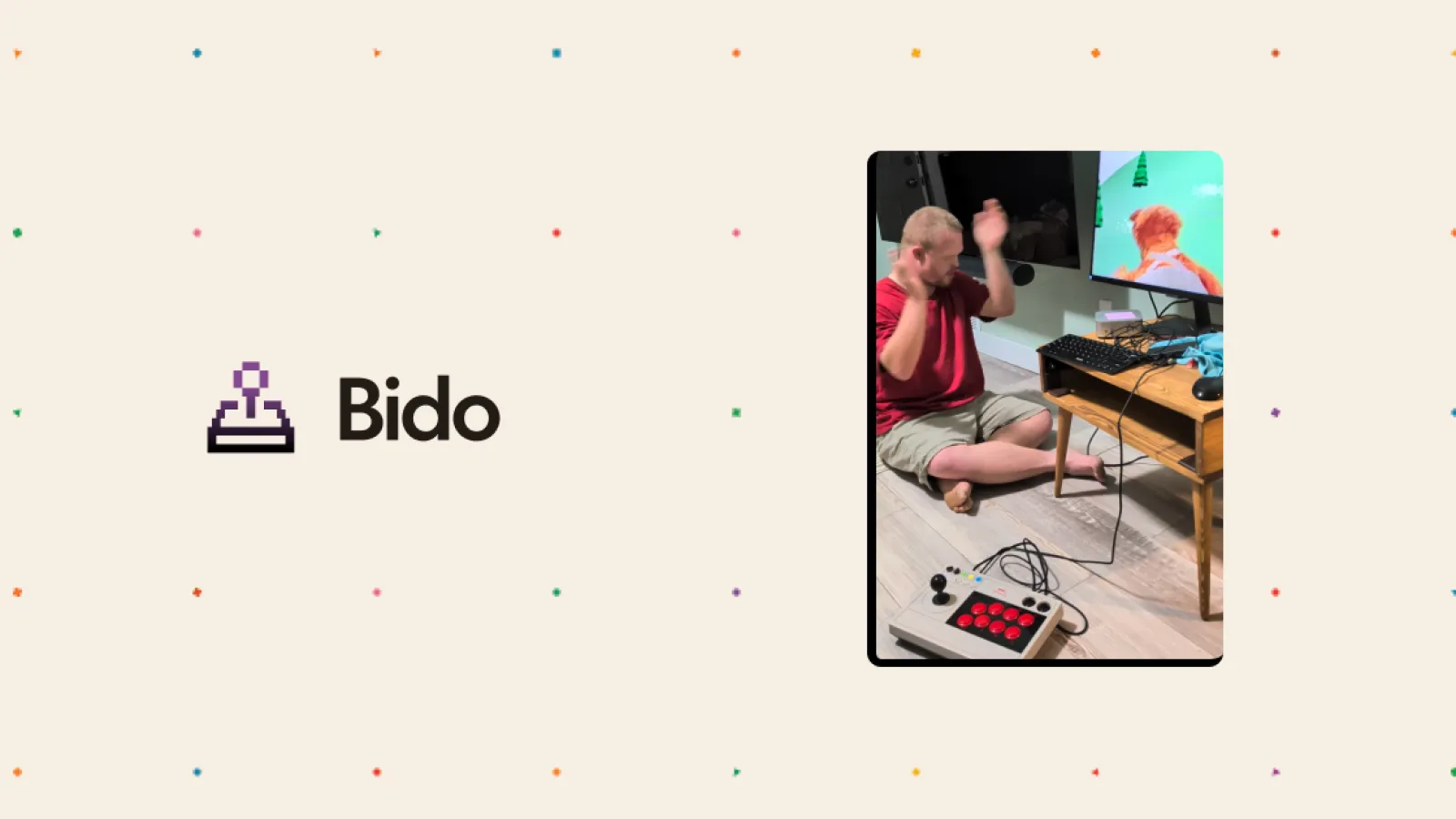
The short version: my brother has Down syndrome, he loves VHS players, and he breaks about one a week. We can't keep buying them. What's the fix? A custom solution that wouldn't normally be possible but is done in a weekend.
One User Is Enough
I built a box this weekend that exactly one person will ever use.
My brother has Down syndrome and he loves VHS players. He has used them his entire life. He puts in a tape, hits rewind, and watches the same little stretch, over and over and over again. He has been doing this for almost thirty years at this point. Have you ever heard the kookaburra song? What about just "sits in the old gum tree" 300 times a day?
The problem is that VHS players are not a sustainable thing to keep buying in 2026. He got to where he'd break one in about a week, and the supply of working ones is finite (they stopped making parts for them a few years ago). So we have known for a while that we needed something else.
A quick aside, because this is the part everyone tries to help with when I tell this story: I appreciate the offer, but please do not send me your old VHS player. They are not the answer. We are past the point where another VCR fixes this. We need a new thing.
Why "just use a DVD player or tablet" doesn't work
On the surface a DVD player looks like the obvious answer. It plays video. It has fast forward and rewind. It is cheap. Easy to use right? Right? (spoiler: wrong)
A VHS player has large physical buttons on the unit itself. They have travel, they click, they're spaced apart. When you hold rewind, the tape spools backward, the picture on the TV scrubs smoothly with it, and you see the result of what you're doing in real time. The thing you're pressing and the thing you're watching are locked together with no delay. That feedback loop is the entire thing. Scrubbing with your finger on a tablet? Not the same. The menu and chapters in a DVD? Not close.
So the obvious replacements aren't actually replacements. They look like they could be, but they aren't, because they break the specific feedback loop that the VHS player was good at.
What I built
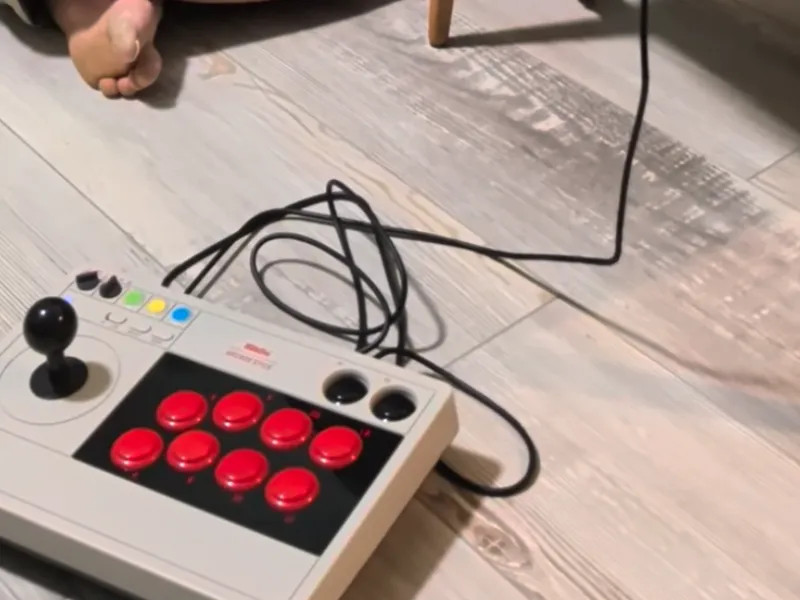
I bought one of those 8Bit arcade boxes off Amazon. The kind with a joystick and a row of big red arcade buttons across the front. I ended up taking out the joystick because that's still a fine motor skill we found out. I gave it to him and he spun the top not understanding the "tilt" part of it.
Each big red button plays a specific video. Hold one of the smaller buttons to fast forward, hold the other to rewind. Press one of the red play buttons to switch between videos. Press the same one to pause then play. That's the whole control surface.
Behind it is a Mac mini running an Electron app. The app is a reskin of something else I'd already built called Bellvue, which is a kiosk-style TV app I had just made for a client for lobby TVs on Mac devices. Bellvue handles all the actual playback, the looping, the video management, plus an online portal where I can change which videos are loaded onto the device. The Bido Box is just Bellevue with a different skin and a different control layer. Had to mess with some encoding things with the videos but most of this stayed the same.
Is a Mac mini overkill for this? Hardware-wise, yes. The whole thing could run on a Raspberry Pi for a fraction of the cost, and I want to migrate it there eventually. Software-wise, no. The Mac mini is running an app that already existed. That's the point.
He has used this thing more, and tolerated it longer, than any of the other replacements we've tried over the last several years and that's the only metric that matters.
Microsoft figured this out
Microsoft first published its Inclusive Design Toolkit in 2015, and the line from that toolkit that gets quoted the most is "solve for one, extend to many." The idea is that if you design for the people at the edges, the users with the most extreme needs, you end up with solutions that work better for everyone else too. The Xbox Adaptive Controller is the famous example, co-designed with disabled gamers, now a global symbol of inclusive hardware. Curb cuts are the older example, designed for wheelchairs, used by everyone with a stroller or a suitcase.
This is such a cool idea. It's how a lot of design work that matters actually gets made. But it's also a sales pitch. "Solve for one, extend to many" is what you have to say to get a company to fund inclusive design work, because companies sell to many, not to one. The "extend to many" is the part that lets the design team get budget.
The Bido Box is not that. The Bido Box solves for one. He is the user the whole thing was built around. If I made fifty of these and tried to sell them as a product, they wouldn't work for the next person, because the next person needs different buttons, a different feedback model, different videos, a different physical form factor. The whole reason this one works is that it was made for him specifically, not for "adults with developmental disabilities" in some general category sense.
The pattern, though, might travel. Make a custom all in one version that parents can use with their kids? Maybe. Make just the controller for adults with disabilities? Maybe. We'll see where we land. Stay in the loop on the Bido Box.
That distinction matters more than it looks. The work is in figuring out the actual user, not in imagining a population. The output fits one person. The pattern travels, the artifact doesn't.
This is also what custom software for a business is
When I tell people I build custom CRMs and internal tools and AI implementations for small and mid-sized businesses, the question I get most often is some version of "couldn't they just buy something off the shelf?"
Sometimes yes. There are plenty of cases where the off the shelf tool is the right answer. But the cases where it isn't tend to look a lot like this. The business is one user. Not "businesses in this industry" or "businesses of this size." THIS business, with its specific people, its specific way of working, its specific quirks and constraints and history.
Off the shelf tools are "solve for many." They average across a category. They give you the version that works okay for everyone in the category and is great for nobody specifically. That is sometimes fine. It is often not fine, and the gap shows up as the slow leak of people building workarounds in spreadsheets and Notion docs that the official tool doesn't quite handle.
A custom build is "solve for one." You figure out what THIS business actually needs, you compose the pieces you have, and you ship something that fits. Like the Bido Box, the custom build mostly isn't from scratch. Bellvue already existed. The arcade box used as the controller already existed. The novelty is in the assembly, not the components. That is also what custom software work looks like. Most of the real expertise is knowing what already exists, what to reuse, what to ignore, and what one specific thing actually needs to be built.
The Bido Box wouldn't make sense as a product for everyone today. That is exactly why it works.
The custom internal tool for your business probably wouldn't make sense as a product either. The vendors selling you "the X for your industry" already exist. If those worked for you, you would have bought them. The reason you need a custom build is that you are one user, and the work is to figure out what fits.
Why this was a weekend project and not a year project
I have wanted to build this for my brother for years. The reason it actually happened this weekend, and not over the next twelve months, is that Bellvue was already in the drawer. I built it for a totally different purpose that did need to be polished, had a solid purpose and customer and that's plenty for something that's close to the same ongoing infrastructure cost as a website.
When the moment came that I had a couple of free days and decided this was the weekend, the question wasn't "how do I build a video kiosk." The question was "how do I take Bellvue and put a new face on it." That's a totally different scope of work. That's a weekend.
This is also part of what working with AI looks like right now, for the kind of work I do. The base systems are increasingly cheap to assemble. Most of the slow part of building software used to be the foundation. The foundation is now closer to a commodity. What's left is the specific thing for the specific user, which is the part that was always hard, and which is the part that AI does not just hand to you. You still have to know the user. You still have to make the choices. You still have to design.
That's the thing I find myself coming back to lately. Build the foundation. Keep it. Use it on the next thing that's worth building. Most of those next things will be small, specific, and made for one user. That's not a problem to apologize for. That's the actual shape of useful work.
I built this for my brother. He uses it. That is enough.